Showing posts with label petunias. Show all posts

Sunday, July 29, 2012

Week 31, Year 3: Petunia Parade

040 Petunias have always been a favorite of mine. The past few years, I’ve planted two varieties of purple wave petunias and let them climb down the railing. This year, however, I had to make a change because I purchased all of my flowers at a different nursery. So, I expanded.  This year’s four petunia varieties play star and supporting roles in the garden.
Starring Roles
The two leading ladies are considered “designer” petunias – which are basically exotic hybrids that have been cultivated by a specific grower to be particularly unique or showy.
Antique Shades Petunias
These petunias are aptly named. They have a romantic shabby-chic-ness to them. Their frilly edges and fading flowers make them look like they’ve actually been “antiqued”. 
026 017
Sticking to the motif, the flowers seem to change color over time, similar to an antiqued cabinet.  The flowers start out with a light, romantic pink fading into light yellow and green centers. However, two months later, the flowers are a deep pink with a golden yellow throat. You can really see the difference in the photos below which show the progression from light to dark flowers.
195110015
“Pretty Much Picasso” Petunias
023
Picasso Petunias were developed by Proven Winners and are relatively new to the scene, but they have quickly become a crowd favorite. With their bright color scheme and trailing waves, Picassos are hard to resist.
Unlike the antique petunias, the link between the petunia and its name is unclear. While Pablo Picasso was known for his bright paintings, these flowers seem unworthy of his name. Unlike a Picasso painting, Picasso Petunias do not reflect the distortion and layering of cubist art, but have very sharp features – the bright purple flowers feature a crisp lime green edge. I have not found much information on the name, so I’m thinking some marketer thought it would make them sound more unique and interesting to name them after the iconic painter.  
050 032
Picassos are wave petunias. Proven Winners advertises them as “vigorous” and they weren’t kidding – my Picassos have overtaken the two containers I’ve planted them in. I’ve cut them back twice and they’ve grown back just as strong.  Despite this, I’ve really enjoyed them and I hope I can find them again next year.
Supporting Roles
Not to be forgotten, my other petunias are playing a supporting role in window boxes and combo pots. Each adds its own brand of cheerfulness and color to its pot.
Blue Vein Double Petunias
029
Double petunias are exactly what they sound like. The cultivator grows two petunia blooms on one stem, creating an extra full flower. My double petunias are wave petunias living in a purple themed window box. Named “blue vein”, my double petunias are a light purple with (you guessed it) a dark blue vein traveling the blossoms.
                    203          286
My one complaint about double petunias is that they are not self-cleaners like regular petunias. So, they need to be deadheaded, but the dead flowers are not that easy to remove since the stems are coated with the same sticky substance as regular petunias.
135
Suncatcher Yellow Trailing Petunias
039              046
Last, but not least, is the suncatcher trailing petunia -- a cheerful white petunia with a bright yellow throat. This sunny petunia is residing at the base of a small ornamental tree. Its trailing elements are the perfect effect for this pot.  The stems cheerfully spill out over the sides of the green container and create weight at the bottom of an otherwise tall focal point.  The slightly smaller blooms also make a great complement to a combo pot. 

Sunday, July 31, 2011

Week 30, Year 2: The Purple Spectrum (the lighter side)

This entry follows up on my showcase of the many purple flowers residing in my garden. This week's entry focuses on the lighter "purples" (from basic purple to violet to light blue). From dark to light, this set includes: clematis, lisianthus, salvia, plumbago and silver petunia.

The "Light" Purples

I've classified this set as "lighter" purple because of the way their petals lighten as they age. Unlike the "true" purples showcased in the last entry, these flowers start out purple, but lighten to a lavender-esque shade as they finish blooming. Among this group, from dark to light, we have: clematis, lisianthus and silver petunia.

Clematis - This year's clematis has been much more successful than last year's attempts. While this variety only bloomed in June, it produced spectacular purple flowers that looked great on the climbing trellis I planted in their container. Clematis are categorized according to whether the new flowers bloom only on new growth, old growth or both year to year. I'm not sure what kind I have, but, hopefully, I will get to find out next year.

Lisianthus - a native prairie flower also known as eustoma. I hope to have a separate entry on it sometime soon.

Silver Petunia - these are a repeat from last year. I just love the delicate coloring that appears almost fuschia in the center and fades to a silverly purple. The photos just can't capture this spectacular coloring, but if you ever see one in your garden store, I highly recommend it!

The "Light" Blues

The flowers in this group look even more blue than their blue-purple cousins. These flowers have cooler notes of light blue petals, ranging from a robin's egg blue to a very light blue. In my garden, this group is represented by the salvia and the plumbago.

Salvia - one of the first plants in this year's garden. Salvia is actually a sage variety that produces small bright blue flowers. Mine is somewhat temperamental and looks kind of dead half of the time, but blooms the other half - I think it depends on whether it is too hot or not.

Plumbago - one of the showier residents of the garden. This trailer produces wonderfully delicate light blue blooms in large heads with individual flowers (similar to a geranium). My only complaint is that it is very sticky, making it hard to dead head.

Wednesday, July 6, 2011

Week 27, Year 2: The Purple Spectrum, Part I (Blue to Royal)

In case it isn't obvious, I love the color purple (or is it blue?). Many of my flowers fall somewhere between deep (blue) purple and light purple (blue). While some of my purple winners will merit their own entries (e.g., clematis, duranta), I will try to showcase the rest of the purple flowers in this entry, and follow up with some other color "themed" entries to highlight the less showy participants in my garden. Since I have so many purple residents, I am splitting my purple entries into two, and this week's purple spotlight will be on the royal, deep "blue" purple residents: browallia, verbena, speedwell, petunias and sweet potato vine. There are several shades of purple, and I've done my best to classify my royal/blue set below.

The "Blue" Purples

Many of the deep, royal purple varieties are actually classified as "blue," reflecting their deep, cool color. A true blue flower has eluded growers to date, and most attempts to create a blue flower have resulted in the deep purple color that is classified as "blue." Whatever its called, this is definitely my favorite color in my garden. While the striking blue-purple of the duranta was highlighted last week, the petunias, verbena, browallia and speedwell are other examples of this great color.

Petunia - These wave petunias look like they are made of velvet up close.


Verbena - Another repeat player from last year, but this time the verbena are getting full-sun, sharing a box with the stock and Mexican heather.


Browallia - The browallia won my heart last year, and I couldn't help but bring them back this year, especially given their tolerance for shade.

Hungarian Speedwell (veronica) - The speedwell is a bit mysterious - it bloomed for about one week in early June and has not produced flowers since.

The "True" Purples

The true purple flowers are more of a royal purple or classic purple hue. These flowers have a warmer tone and can range from an eggplant to violet, stopping short of the lighter lavender shades. In this group, from dark to light, we have painted tongue, sweet potato vine and heliotrope.

Painted Tongue - Though the painted tongue has also produced yellow and red flowers, these eggplant stunners are the focus of this entry.

Sweet Potato Vine - This variety of sweet potato vine ranges from chartreuse to eggplant, providing the perfect complement to the silver and purple petunias.

Heliotrope - The heliotrope is incredibly fragrant. I grew it in a box last year, but decided to let it have its own pot this year. It's a bit floppier and I think I might have preferred it in the box, but it still smells incredible.

Tuesday, June 21, 2011

Week 25, Year 2: The Teenage Years

My garden is in an awkward in between stage. While many of the plants have grown significantly, they are in a weird place where they are looking a bit unfinished. They can't decide if they are going to play nice with one another and everything is looking a bit unkempt as a result. Half of them are growing in every which direction, refusing to be trained and still resisting gentle directioning. Essentially, they are acting like rebellious teenagers. Here are some examples:

The Rebels

The rebels are the plants that just refuse to cooperate. They are dead set on defying me.

Plumbago - The plumbago is a late bloomer. Supposedly, it will grow downward, but right now, it really is only willing to grow straight up. Eventually, the weight of the branches should cause it to fall downward, but until then, it just grows straight up and leaves the box feeling unbalanced.

Clematis - Similar to the plumbago, the clematis does not want to grow downward. While I bought it a nice fancy trellis, it is happier growing straight up, even when I wrap its vines around the trellis.


The Ugly Ducklings

These guys are just on the verge on greatness, but have to go through a final round of acne and braces before they truly bloom.

Lisianthus - This is a native prairie flower. It has grown into an incredibly tall plant, but has yet to bloom. However, it has just developed buds, and I have to believe it is on the verge of greatness, but I'm not sure what it needs to take that final step.


Mandevilla - The mandevilla is supposed to be a vigorous climber. The only problem is that it thrives in humidity. We haven't exactly had the best weather lately, and the plant has struggled for it. However, it is just starting to come along and has developed several buds - I feel like it has turned the corner and should be growing fairly quickly in the coming weeks. Unfortunately, I don't have a very good picture as I planted oregano and parsley in the pot and they sort of obscure the image, but I'll be sure to post a picture once it turns the corner.

The Nerdy Freshmen

These guys are seemingly stuck in those horribly awkward and uncomfortable stages. Oddly enough, these were some of my best performers last year, so I have faith they will get it together eventually.

Petunia & Sweet Potato Vine - The plants in this box are at a weird length. They aren't ready to grow downward yet, but they are too long to grow straight out - so they are just growing in every which direction. I'm trying to steer them in the right direction, but they seem to be struggling with it for now.


Portulaca - also known as cabbage rose, these guys are certainly proving it. So far, no buds or blooms have grown, but we have seen a number of thick vines that look almost like dreads. I'm not sure what to make of this guy to be honest, but I hope he figures it out soon.


The Prom Queens

Like any annoying popular kid, these guys are simply showing off and enjoying their glory days. Here's a quick photo tour:

Painted Tongue - There's a new color every week with these unique blooms. So far, I've seen red with yellow stripes, yellow with light yellow stripes, purple with yellow stripes and deep red/purple with matching stripes.


Flowering Maple - The painted tongue's box mate is also having a nice June. While not as splashy as its neighbor, it is quietly producing bloom after salmon bloom.


Stock - The stock is beautiful and fragrant, though not bullet proof. Like any teenager, it has its problems. In this case, the new growth is the definition of awkward. The blooms seem to shoot out of these spiky little sticks and I can never tell if the sticks have yet to bloom or not.


Sunday, May 8, 2011

Week 18, Year 2: New Beginnings

Well, it's time to start again. Having survived my rookie year, I'm heading into Year Two with the hopes of cultivating another beautiful container garden, having fun and learning a lot more along the way. Unfortunately, I had to give up on last year's perennials. Life intervened, and I was too busy to nurse them along, so I've decided to start fresh. The lone survivor was snoke poke, our blue spruce tree. So, on this beautiful Mother's Day, my faithful assistant (pictured above) and I spent the morning on the deck planting the first group for 2011.


My sister also contributed a wonderful addition to the garden - a basket for my supplies! Last year, I got really sick of looking at all of these items strewn about inside the deck door. So, I'm really enjoying this new addition.
Although none of my flowers survived from 2010, I did pick up some repeaters of varieties that I really enjoyed. My main goal, however, is to keep learning and trying to grow new kinds of flowers in my containers. My first batch comes from Johansen's Greenhouse in Madison. Like last year, I went for a mix of annuals and perennials. I planted all of them with an outdoor potting soil. I'm not sure if all of these are going to make it in containers, but that's part of the adventure! Now, without further ado, it's time to welcome the initial members of the Class of 2011:


Papavera Poppy - This is probably the riskiest plant to try to grow in a container. I just love poppies, so I thought I would give it a shot, but I'm not sure how successful this will be.

Snowpoke was the lone survivor from year 1. He doesn't have a lot of room to grow, but he continues to plod along.


Oceana Blue Salvia - This member of the sage family produces bright blue, stalky flowers.


Lisianthus - I'm not sure if I will like this one or not, but I was curious enough to give it a go. It produces tall flowers that have a more old fashioned look to them. I'm not sure what color I will get, the tag claimed "blue" but the picture had a mix of pinks.


Black-Eyed Susan Vine - Last year's favorite is back, but this time, we are trying it in orange!


Rieger Begonia - this is another repeat from last year. Its shade loving nature makes it a great option for my deck and it was so successful last year, that I had to go for it again.


Window Box #1: Hungarian Speedwell, Portucala, Plumbago


Plumbago - this plant is supposedly a pretty good climber, and produces light purple blooms. I'm hoping it will climb down like the petunias.


Portulaca - this plant, also known as moss rose, produces bright yellow flowers with red centers. The cactusy like leaves give it a little edge, and I think it should be a good contrast to its purple box mates.


Hungarian Speedwell - not to be confused with the feisty Hungarian Horntail dragon that Harry

Potter defeated in the Triwizard Tournamnet, this plant is a variety of Veronica that produces purple flowers (a.k.a. "Crater Blue").


Window Box #2: Verbena, Mexican Heather & Lisianthus

Verbena - This was a great success last year, and loves the partial shade, so I picked it up for a second turn at bat.
"Allyson" Mexican Heather - a tough sprawler with fuschia buds.


Finally, I had extra lisianthus, so I stuck them in this box. I don't think they will stay here, but until I decide what to do with them, they'll be hanging out in here.


Window Box #3: Petunias

I just loved the way these trailed down the balcony last year. The deep blue purple and silvery purple flowers also made for a lovely contrast, so I've decided not to mess with success. They are back and in the same spot.


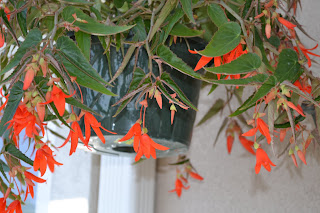
Hanging Basket #1: "Bonfire" Begonias

This hanger houses a unique variety of begonia with fire red blooms. Although red is not in my usual color palette, I couldn't resist the bright, cheerfulness of this hanger.