Showing posts with label browallia. Show all posts

Wednesday, July 6, 2011

Week 27, Year 2: The Purple Spectrum, Part I (Blue to Royal)

In case it isn't obvious, I love the color purple (or is it blue?). Many of my flowers fall somewhere between deep (blue) purple and light purple (blue). While some of my purple winners will merit their own entries (e.g., clematis, duranta), I will try to showcase the rest of the purple flowers in this entry, and follow up with some other color "themed" entries to highlight the less showy participants in my garden. Since I have so many purple residents, I am splitting my purple entries into two, and this week's purple spotlight will be on the royal, deep "blue" purple residents: browallia, verbena, speedwell, petunias and sweet potato vine. There are several shades of purple, and I've done my best to classify my royal/blue set below.

The "Blue" Purples

Many of the deep, royal purple varieties are actually classified as "blue," reflecting their deep, cool color. A true blue flower has eluded growers to date, and most attempts to create a blue flower have resulted in the deep purple color that is classified as "blue." Whatever its called, this is definitely my favorite color in my garden. While the striking blue-purple of the duranta was highlighted last week, the petunias, verbena, browallia and speedwell are other examples of this great color.

Petunia - These wave petunias look like they are made of velvet up close.


Verbena - Another repeat player from last year, but this time the verbena are getting full-sun, sharing a box with the stock and Mexican heather.


Browallia - The browallia won my heart last year, and I couldn't help but bring them back this year, especially given their tolerance for shade.

Hungarian Speedwell (veronica) - The speedwell is a bit mysterious - it bloomed for about one week in early June and has not produced flowers since.

The "True" Purples

The true purple flowers are more of a royal purple or classic purple hue. These flowers have a warmer tone and can range from an eggplant to violet, stopping short of the lighter lavender shades. In this group, from dark to light, we have painted tongue, sweet potato vine and heliotrope.

Painted Tongue - Though the painted tongue has also produced yellow and red flowers, these eggplant stunners are the focus of this entry.

Sweet Potato Vine - This variety of sweet potato vine ranges from chartreuse to eggplant, providing the perfect complement to the silver and purple petunias.

Heliotrope - The heliotrope is incredibly fragrant. I grew it in a box last year, but decided to let it have its own pot this year. It's a bit floppier and I think I might have preferred it in the box, but it still smells incredible.

Sunday, August 29, 2010

Week 16 - Year 1: And Then There Were None

Like the character's in Dame Christie's epic thriller, my plants are dropping off like flies. This is probably not surprising as we are reaching the end of summer and transitioning torwads fall. This month my plants have battled with being indoor refugees, humidity, weird infestations, dropping nighttime temps, heavy winds, downpours and extreme changes between dry and humid air. Needless to say, not all of them have made it. Here's an update on the latest casualties:

Browallia

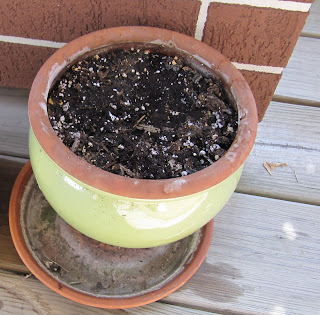
Sadly, it looks like these guys got the bug infestation. They began wilting and turning brown in early August and finally gave up the fight mid month. I left the roots in the container because browallia is supposedly a perennial. However, if it died from a disease, it may not come back at all and/or infect my other plants, so it is a catch 22. I think I will have to quarantine it over winter. I am still watering it though with winter in mind.

Sunflowers

These guys barely made it a week! They just wilted and never recovered. I had planted them in the container that was previously inhabited by the now departed campagnula, which had the little white flecks all over it and in its soil. We thoroughly cleaned the container, but apparently it wasn't enough because I found the same white flecks in the sunflower's soil. It's depressing to lose these guys so fast.

Begonias
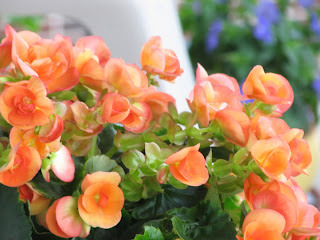
Early this week, I discovered that half of the begonias had basically given up. It looks like the plant got too heavy for its stem and just keeled over. Fortunately, 1/3 of the plant was still standing up right so it is not totally dead. I was able to salvage the other 2/3 as cut flowers to enjoy at the office.


Saturday, August 7, 2010

Week 13 - Year 1: Emergency Succession Planning

My garden is under siege, and we are not winning. Unfortunately, it looks like the trip inside may have invited a few nasty pests to wreak havoc on our plants. Early this week, I noticed small white dots on the bidens and calibrachoa in the middle container, and on the champanula. Plus, there were green dots on the nicotiana. I did some internet research and did not come up with much on the white dots, but figured the green dots were the most dreaded of all garden pests - aphids.
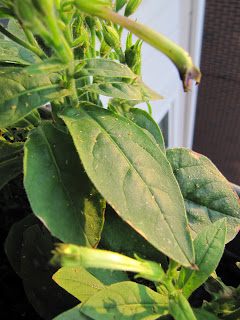
I'm still not sure what the white dots were, but various home remedies all failed, and I had to say good bye to the victims. I tried two solutions. The first was a combination of water, liquid dish soap and baking soda in a spray bottle. The second substituted vegetable oil for baking soda. The idea is to spray the leaves to get the buggers to slide off and not come back. It was definitely too late to get rid of the white guys. The aphids seemed to respond to the vegetable oil, but I'm still not sure if the battle has been won and it looks like they may be attacking the browallia.
Unfortunately, I had to trash the bidens, coral calibrachoa and champanula. I tossed the dirt in all of their containers too and scrubbed the containers down to try to get rid of the bugs. I also bought some organic insecticide to try to wage my own war on the invaders to prevent further contamination. We will see how that works out. So far, it's bugs 3, Me .5 (nicotiana are still hanging in there).
So, we had some openings in our garden and it was time for some succession planning. It is a bit early to be thinking fall, but I figure there is not enough summer left to plant any thing but hardy fall winners. So, here are the successors:

Replacing the bidens & calibrochoa in window box #2: Hardy mums & lemonade lantana.
Replacing the champanula - Sunflower hybrid.

New addition - Z_____ (I know it starts with a z, but I can't remember anything else!).
These guys have the funniest new buds. They hold everything in until they are ready to open, so they look like little pouches.

Monday, July 26, 2010

Week 11 - Year 1: The Good, the Bad and the Ugly

While I've already discussed the Bad (See Life Support) and the Ugly (See RIP), I thought I would continue my progress report of sorts by looking at the "Good." Overall, many of my plants are doing exceptionally well and I'm very happy with the progress I have made in my first attempt. Using the law school curve (forgive me, but its still pretty fresh in my mind), I would grade my "good" guys as follows:

The "A+"s (yes, they have A+s in law school, for the "best" in class):

Black-Eyed Susan Vine

This plant has always been a sure winner. From the first day, it has thrived. The only problem it faces is that it is out of room to grow. It is starting to grow downward on to the porch below, but I do not think it will grow long enough to actually get in anyone's way (at least I hope not).

Petunias

These guys are obvious winners. They have succeeded in spindling down their vines and make a nice visual from across the parking lot when you drive up to our building. I've even taken snippets in vases with me to work and they manage to last a full week without natural sunlight in a vase. I highly recommend them for any beginner. I chose to omit the picture, because they've already been featured a lot in this blog.

The "As":

Shamrock

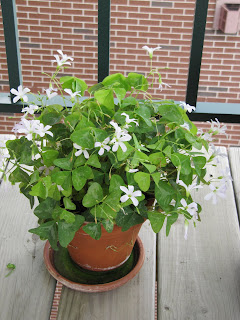
I'm very proud of this little guy because it was near death when I bought it. I've nursed it back to health and it seems to be doing very well. The flowers are very understated, but incredibly charming up close as the the leaves & flowers look like shamrocks with little bells on them.

Browallia

This little guy has tripled in size. I started out with one straight shoot of leaves and flowers and now have a large, round plant with lots of blooms. This one does not require much maintenance and is happy to just keep blooming without interference.

Verbena

This plant is also thriving. It just keeps spreading and brightening up its box. It is also easy maintenance and often just chucks the dead heads itself.

The "Bs":

In law school, every class must finish with a B average, so most of my plants should fall in this category on this curve. Since math is not my strong suit and I'm too lazy to showcase every plant and figure out what their grades should be on a curve, I've featured the more interesting Bs below.

Morning Glory

This plant started out as an A with steady blooms. However, they have been downgraded to a B because it has not bloomed in a few weeks. I think its because the morning glory only wants to grow upward and it has nowhere to go, so it keeps growing on itself.

Every time I look at it, I can't help but think "Its alivvvvvvve" and it creeps me out a little. I could try planting a trellis, but we are already in July, so I will probably let it go for now. I just try to keep it from attacking the heliotrope, but otherwise let it do what it wants.

Sweet Potato Hanger

This hanger of vines is also doing exceptionally well. While it does house some neighborhood birds, it has managed to growth very large and withstand drought and bird-mangling. Some days it is looking more peaky than others, but it always bounces back, which is a great quality in a plant destined for a rookie's garden.

Begonias

This guy keeps wavering between A and B territory. Mostly, because he can't stand up straight. He keeps leaning. I will pack more soil in there, but inevitably, he eats it up and starts to lean again. Otherwise, he looks great.