Showing posts with label clematis. Show all posts

Saturday, July 21, 2012

Week 30, Year 3: Clematis Files

139 Yes, you read that right – I still have not learned my lesson and I’m back for more punishment at the hands of a clematis vine. For those of you who have followed this blog from the beginning, you know that clematis have been a particular struggle for me. The beautiful climbing vine has a mind of its own, and that mind usually does not prefer confinement in a pot. While many Wisconsin gardeners find easy success with clematis, I’ve always been challenged to find success. The critical difference is of course the container. Clematis are just not meant to be container plants, but for some reason, I’m bound and determined to try year after year.

041 This year, I really thought I would resist. I truly had no intention of buying a clematis (do I ever?). However, I just could not resist this year’s clematis when I saw it growing on this beautiful trellis. So, I figured the clematis struggle would be worth the long term joy of the trellis, which could easily be repurposed for less frustrating endeavors once I killed off the clematis. 

029


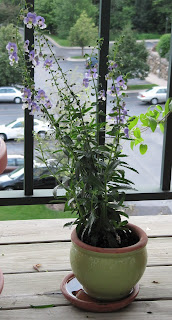
So, I set this year’s clematis up to be even more of a failure than the others. I planted it in a small pot without much concern for its well being and I shoved the angel wing begonia in it four weeks later when I was looking for a place to put the cutting. Once the original flowers died, I sat back and waited for the shriveling, frustrating misery of years past.

Well, the joke was on me. Apparently, clematis really do have a mind of their own – a contrary, curmudgeony, stubborn mind. This year’s plant must have realized I wanted it to do die, so it decided to thrive instead. Two weeks later, a bud emerged and bloomed a few days later – into a healthy, purple flower.  177

098


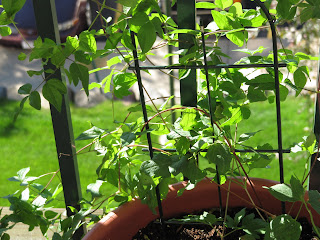
It’s bloomed twice since I bought it  and it has continued to grow on the trellis. The vines are healthy, the leaves look great and it hasn’t shriveled up after blooming. Frankly, I don’t understand it, but I’ve stopped trying to because I figure the minute I actually think about it, the clematis will die. I’m keeping my fingers crossed that this post doesn’t send it over the edge.

113

Monday, August 15, 2011

Week 33, Year 2: The Clematis Files

Back to clematis. Last year's attempts were a disaster. I planted two varieties and both were fairly pathetic. One never bloomed, and the other finally produced a couple pitiful flowers after having survived my "pruning" (a.k.a. butchering). It should have been clear that clematis was not meant for my containers, yet, a glutton for punishment, I thought I would try again despite the evidence. If last year was a C, I think this year is closer to a B+/A-.

This year's hopeful is dubbed "El Presidente" and produces large purple flowers. I got smarter and bought this clematis a little later in the season, so it wouldn't whither from the cold again. It also had a couple flowers already in bloom, so I knew I would at least get to enjoy something. Clematis is supposed to bloom in early June, so I knew I didn't have much time to produce a winner. I planted it in a large container with a trellis for it to climb, instead of trying to force it around our deck spindles. I put pansies and the bonfire begonia at the bottom to keep its feet "cold." I also put it in a sunnier spot, hoping that would help force it along.


Early on, it seemed I had another failure on my hands. The flowers that had been blooming on the plant when I purchased it had wilted (see the rather pathetic drooping above), and the stems had turned a nasty shade of brown. We left for a week of vacation, and I was fearful that I would be returning to a rather nasty scene clematis wise.


However, to my surprise not all was lost in our absence. Despite the 100 degree days, there was new growth on our plant when we returned. By solstice, we had buds, which turned into a couple new blooms.


We saw another two flowers by independence day. After that, it seemed like the clematis went on hiatus again, but last week it produced another two blooms and more new growth. I'm not really sure how to interpret this, but I have reached the following conclusions:


- this variety of clematis only produces 2 flowers at a time (that or it just hates me specifically)

- the climbing trellis is a must have for a potted clematis

- always plant something exciting at the bottom to distract from any failures at the top (e.g., the spectacular begonias)

- I still don't know what I'm doing clematis wise, but I've progressed enough to justify more punishment next year

Sunday, July 31, 2011

Week 30, Year 2: The Purple Spectrum (the lighter side)

This entry follows up on my showcase of the many purple flowers residing in my garden. This week's entry focuses on the lighter "purples" (from basic purple to violet to light blue). From dark to light, this set includes: clematis, lisianthus, salvia, plumbago and silver petunia.

The "Light" Purples

I've classified this set as "lighter" purple because of the way their petals lighten as they age. Unlike the "true" purples showcased in the last entry, these flowers start out purple, but lighten to a lavender-esque shade as they finish blooming. Among this group, from dark to light, we have: clematis, lisianthus and silver petunia.

Clematis - This year's clematis has been much more successful than last year's attempts. While this variety only bloomed in June, it produced spectacular purple flowers that looked great on the climbing trellis I planted in their container. Clematis are categorized according to whether the new flowers bloom only on new growth, old growth or both year to year. I'm not sure what kind I have, but, hopefully, I will get to find out next year.

Lisianthus - a native prairie flower also known as eustoma. I hope to have a separate entry on it sometime soon.

Silver Petunia - these are a repeat from last year. I just love the delicate coloring that appears almost fuschia in the center and fades to a silverly purple. The photos just can't capture this spectacular coloring, but if you ever see one in your garden store, I highly recommend it!

The "Light" Blues

The flowers in this group look even more blue than their blue-purple cousins. These flowers have cooler notes of light blue petals, ranging from a robin's egg blue to a very light blue. In my garden, this group is represented by the salvia and the plumbago.

Salvia - one of the first plants in this year's garden. Salvia is actually a sage variety that produces small bright blue flowers. Mine is somewhat temperamental and looks kind of dead half of the time, but blooms the other half - I think it depends on whether it is too hot or not.

Plumbago - one of the showier residents of the garden. This trailer produces wonderfully delicate light blue blooms in large heads with individual flowers (similar to a geranium). My only complaint is that it is very sticky, making it hard to dead head.

Tuesday, June 21, 2011

Week 25, Year 2: The Teenage Years

My garden is in an awkward in between stage. While many of the plants have grown significantly, they are in a weird place where they are looking a bit unfinished. They can't decide if they are going to play nice with one another and everything is looking a bit unkempt as a result. Half of them are growing in every which direction, refusing to be trained and still resisting gentle directioning. Essentially, they are acting like rebellious teenagers. Here are some examples:

The Rebels

The rebels are the plants that just refuse to cooperate. They are dead set on defying me.

Plumbago - The plumbago is a late bloomer. Supposedly, it will grow downward, but right now, it really is only willing to grow straight up. Eventually, the weight of the branches should cause it to fall downward, but until then, it just grows straight up and leaves the box feeling unbalanced.

Clematis - Similar to the plumbago, the clematis does not want to grow downward. While I bought it a nice fancy trellis, it is happier growing straight up, even when I wrap its vines around the trellis.


The Ugly Ducklings

These guys are just on the verge on greatness, but have to go through a final round of acne and braces before they truly bloom.

Lisianthus - This is a native prairie flower. It has grown into an incredibly tall plant, but has yet to bloom. However, it has just developed buds, and I have to believe it is on the verge of greatness, but I'm not sure what it needs to take that final step.


Mandevilla - The mandevilla is supposed to be a vigorous climber. The only problem is that it thrives in humidity. We haven't exactly had the best weather lately, and the plant has struggled for it. However, it is just starting to come along and has developed several buds - I feel like it has turned the corner and should be growing fairly quickly in the coming weeks. Unfortunately, I don't have a very good picture as I planted oregano and parsley in the pot and they sort of obscure the image, but I'll be sure to post a picture once it turns the corner.

The Nerdy Freshmen

These guys are seemingly stuck in those horribly awkward and uncomfortable stages. Oddly enough, these were some of my best performers last year, so I have faith they will get it together eventually.

Petunia & Sweet Potato Vine - The plants in this box are at a weird length. They aren't ready to grow downward yet, but they are too long to grow straight out - so they are just growing in every which direction. I'm trying to steer them in the right direction, but they seem to be struggling with it for now.


Portulaca - also known as cabbage rose, these guys are certainly proving it. So far, no buds or blooms have grown, but we have seen a number of thick vines that look almost like dreads. I'm not sure what to make of this guy to be honest, but I hope he figures it out soon.


The Prom Queens

Like any annoying popular kid, these guys are simply showing off and enjoying their glory days. Here's a quick photo tour:

Painted Tongue - There's a new color every week with these unique blooms. So far, I've seen red with yellow stripes, yellow with light yellow stripes, purple with yellow stripes and deep red/purple with matching stripes.


Flowering Maple - The painted tongue's box mate is also having a nice June. While not as splashy as its neighbor, it is quietly producing bloom after salmon bloom.


Stock - The stock is beautiful and fragrant, though not bullet proof. Like any teenager, it has its problems. In this case, the new growth is the definition of awkward. The blooms seem to shoot out of these spiky little sticks and I can never tell if the sticks have yet to bloom or not.


Saturday, July 31, 2010

Week 12 - Year 1: The Great Indoors?

The downside of living in an apartment building is that you do not have much in the way of property rights. This week, I was painfully reminded of this fact when we received a note that the building would be power washed on Thursday and Friday and that residents were to remove all decorations from their porches, unless of course you were okay with having them be blasted in a blaze of water glory. Immediately, I was concerned for our plants.
We moved almost everything inside (while dealing with the additional challenge of putting them somewhere out of our cat's reach). It made a pretty funny picture - lining everything up on whatever ledge we could find. The whole apartment smelled like a garden when I woke up the next morning.
But, not everything was easy to move. The black eyed susan, clematis and morning glory have all wrapped themselves hopelessly around the spindles - leaving me in a catch 22 situation - move them and risk destroying them or leave them and risk a drowning. And, even with the ones we could move, who knows what lack of sunlight and closed conditions could do to them? Therefore, we decided to leave them outside and risk it. We also had to leave a couple window box hangers out because we discovered that a family of hornets had moved in, and we did not have any Raid handy for an attack.
To make matters worse, it rained on Friday and when I got home terrified to see what had happened, it appeared that no one had been there at all and our neighbors said they had not noticed any difference either. Of course, we had to move everything back outside, but we may be doing this whole thing again on Monday ...

Moving everything inside did bring some fun revelations though. For one, we have definitive proof that there was indeed a bird's nest in the sweet potato/coleus hanger. Fortunately, it has since been abandoned (could you imagine having to try to bring that inside with a defending mommy bird in the mix?). It's kind of hard to see, but I tired to capture it:
Second, the petunias' color is even more unique under house lighting. While they appear to be a silvery purple outside, inside they have pinky edges while the deep purple ones appear to blue indoors. Similarly, the shamrocks seemingly white flowers are actually the palest shade of lavender (though the photos were not able to capture this).

Monday, July 5, 2010

Week 8 - Year 1: The Clematis Files

Unlike Harry Potter, I do not have a Resurrection Stone, but there must be some magic in the air because the Clematis are back and in business. Back in May, it seemed like I had taken a wrong turn with the clematis and I had trimmed them back down to start over. 5 Weeks later and it seems to be working. I moved both plants to the eastern exposure of the porch and replanted their soil. They both have new growth and the purple one is even blooming, while the red one has 5 buds about to bloom.
The purple one is really taking off.

It has grown vines all over the porch spindles and is even attempting to attack the petunias' box (which should make for an interesting fight given the petunia's battle history).

The red one was a bit slower to respond, but seems to be on its way. It has a healthy amount of vine growth and tons of new buds ready to bloom. The only lingering problem is that it hasn't really stuck itself anywhere yet, so it just sort of hangs there hoping to get comfortable. I keep wrapping it around spindles to inspire it, but it just doesn't take.
If these guys make it, the next worry will be winter. These are perennials and I would like to try to save them is possible over the winter. I've started devising an experiment upon the suggestion of a great co-worker, who has been the best gardening advisor. She has generously offered to plant them in her yard to see if they make it through the winter. So, as an experiment, I'm thinking we plant one and then I winter the other in the damp storage unit in the basement parking garage to our apartment building. It will be interesting to see if they make it. However, this is only July, so I've got a lot of time to plan this experiment. For now, I will just continue to baby these guys and enjoy their progress.

***7/24/10 - Update, the red one finally bloomed and it's spectacular! It's actually more of a magenta than a red, but either way it's gorgeous!

Tuesday, June 29, 2010

Week 7 - Year 1: Dead Heads


Unlike Jerry's famed followers, my dead heads get their name from less ethereal sources. In gardening, the dead heads are simply what they sound like - the dead, shriveled up buds on a flower. I'm still mastering the art of deadheading - figuring out which heads need to be removed to spark new growth and which are "self-cleaning" and will take care of it themselves. There are apparently four ways to "deadhead" a plant - Snipping, Snapping, Shearing or Pinching - all of which sound uncomfortable and surely make any male wince at the thought. In my garden, I've been dealing with all of the techniques with varied success.

Here's what I know:

The Pinchers

The lowest (well besides self-cleaners) maintenance and the most intuitive. You just "pinch" the deadhead off the stem.
  • Begonias
  • Pansies
  • Petunias (optional)
The Snippers

Here's where the tools come in - you use a hand pruner to cut the dead bud right before the first leaf.
  • Campanula (can also be snapped or pinched)
  • Heliotrope
  • Nicotiana
  • Roses
The Snappers
This requires you to "snap" the flower off at the base. It really only applies to really long flowers like geraniums that have a large head.
  • Snapdragon
The Shear-ers

This requires the large scary shears to do some serious cutting. I just use my hand pruners since containers aren't going to grow big enough to justify that kind of blade.
  • Campanula
  • Snapdragon
The Self-Cleaners

These are the easy guys. Though it can be hard to resist the temptation of snapping off the dead plants, the rule is that these guys can take care of themselves.
  • Bidens
  • Calibrachoa
  • Lobelia
  • Verbena
  • Wave Petunias
The Big Projects - Pruners


Then, some plants are so high maintenance that they require annual, complicated pruning in early spring:
  • Clematis

Unknown

With the rest, I've been going with my gut since I haven't found any great insight on the worldwide web.

But, what to do with the deadheads? I'm not entirely sure. Sometimes, I just throw them over the deck. Other times, I test them out as fertilizer for some of the bigger pots, but I'm not sure how effective it is ....


Saturday, June 12, 2010

Week 5 - Year 1: June Showers, Bring July ____?

Before we started gardening, I used to love rain - the smell, the sounds, and the excuse to snuggle up with a good book were a great way to spend a day. Now that I'm gardening, me and the rain gods need to have a talk. We have had rain for a week straight and the forecast predicts more gray and more rain are in our future. I'm wondering if June has become the new April in Madison.
Last weekend was especially bad. Things got so bad with the wind and massive downpour that we had to have an emergency rescue mission, which is what the picture at the top of the blog shows. The window boxes were being pummeled and the pots along the sides were being blown in every direction. So, in the midst of it all, I went out and moved everything to the center. The rain was pretty severe and water was running everywhere.
While the rest of the week days were not as bad, we did not get any sun either, and it's starting to wreak havoc on the garden. I had to move the African Violet inside because I was afraid it could not take this outdoor deluge. The roses have not bloomed since the beginning of the rain. The Morning Glory's leaves are starting to decay. The heliotrope and verbena have not had any new growth and are starting to look sad. The pansies are wilting (in fact, I had to toss some of the ones I had replanted in the Clematis containers). And, the Osteospermum got so excited that it bloomed all at once, keeled over and gave in. This was what was left of the carcass.
However, all hope is not lost yet. The clematis are actually doing pretty well all things considered and some of the smaller pots are starting to bloom. While sun may be coming mid week, I am hard pressed to believe the weather man and am wondering if a grow light would be a better investment.