Showing posts with label begonia. Show all posts

Tuesday, July 17, 2012

Week 29, Year 3: Beautiful Begonias


This week's post is all about the Bs. And no, I'm not talking about Beyonce. Begonias - big, beautiful and bold begonias. Each year, I've had one begonia occupying my side table for our chairs, but this year's garden is a begonia festival, host to three varieties - Tuberous, Ballerina and Angel Wing (maybe).

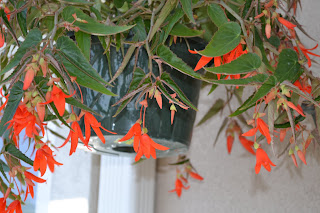
Although they are often overlooked for flashier annuals, there is so much to love about begonias. The way the flowers bloom is incredibly unique. Each bloom grows from underneath the leaves, starting with a small envelope and exploding into a cascading bloom.
282
081
The leaves could give hostas a run for their money. The underside is always rich in red details while the top shows interesting textures and patterns. The flowers themselves last for a long time and continually bloom if you get it right. They are always delicate and show an incredible depth in texture and color. What’s more, they are easy to grow. They love shade to part shade and are drought tolerant. Plus, begonias are easy to propagate (see the prequel post) – which brings us to the first variety.


Spotted Angel Wing Begonia (I think)
033
This plant was the result of a cutting a fellow gardener took from her sister’s overgrown begonia bush. I’m not entirely sure of its variety, but a quick Google search suggests its a Spotted Angel Wing Begonia. The giveaway is in the leaves, which have unique white spots.

074
I have it planted with my clematis. It hasn’t bloomed yet (probably due to its week long stay in the fluorescent lighting of office), so I can’t be sure, but I haven’t found any other varieties with this unique leaf pattern. Even without flowers, this is a great plant. The detail in the leaves is fantastic, especially the underside of the leaves – an unexpected bright and juicy red.


Ballerina Begonia
If propagation isn’t for you, the next option is to grow from seed/bulbs. I picked up my ballerina begonia bulbs at a garden show in February and planted them during a warm spell in March. Now, they are all grown up and ready for their blog debut. A unique begonia, the ballerina enjoys the spotlight, tolerating full sun. The leaves are equally eye catching,  showing a bright chartreuse. 
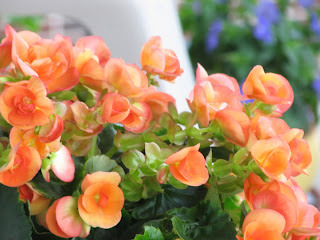
080 But in truth, as with any prima ballerina, this plant is all about the unique, ruffled flowers. The layered texture evokes the taffeta of a blushing ballerina. The colors honor the theme, layers of hot pink, orange and canary softening into pale yellow, apricot and ballerina pink.
099                                                       104


Tuberous Begonias


Finally, if seeds and root cuttings are too much work, there is the ready to go greenhouse option – which brings me to the last variety. The tuberous begonia is probably the most common begonia varietal at your local greenhouse. These annuals have benefitted from breeders and hybridizers and come in a variety of sizes, flower shapes and growing styles. Tuberous begonias are so-named after their thick “tuberlike” root systems. They can grow upright, planted in containers with branches growing skyward, or pendulous, planted in hanging baskets with branches drooping downward. The leaves on the upright are jagged-edged arrows, ranging in colors from shades of green to variegated reds and bronze patterns. The flowers can be single or double ruffled layers curling outward, or straight, rose-like layers curling inward.


In my case, I have two upright tuberous begonias growing in my garden – apricot and yellow.

034

The yellow version has its own pot and first occupied the treasured side table spot of my predecessor begonias.  The variegated leaves have a network of maroon veins running through their tops and bottoms.  


The tag claims the flowers are pure yellow. However, my plant seems to have other ideas in mind. When it first bloomed, I had bright pink buds, which quickly grew into ruffled globes on par with the ballerina, showing layers of yellows, pinks and oranges. 
280 009
The apricot tuberous begonia is hanging out in one of the more colorful combo pots.  This guy is a fighter and has been in continual bloom since first planting. While the leaves are a relatively straightforward green, the flowers are incredible. Apricot is actually a vivid orange that has traces of translucent pinks, yellows and purples on the edges. 

Sunday, March 18, 2012

Week 11, Year 3: An Early Taste of Spring

Wisconsin has been blessed with temperatures of 70 degree this week. Although I had not even intended to start my garden until late May, I could not resist the early opportunity to plant. I've been busy this winter and attended my first garden show. It was pure heaven for the avid gardener and I picked up a couple of great experiments for this year's garden. I tend to stay away from bulbs and perennials because my containers do not lend themselves to winter maintenance. However, I decided to venture into unchartered territory and picked up two bulbs. I had intended to plant them in April, but I was too eager to make use of the early sunshine that I planted them this weekend.

One of my favorite flowers is the Amaryllis. It is typically an early spring indoor bloomer, which is why I've stayed away from it. However, a fellow gardener told me that you can plant amaryllis anytime of year and that her mother enjoyed the blooms and foliage in her garden into late summer. So, I figured I would give it a shot. The second bulb variety was a ballerina begonia in apricot. These should be beautiful trailers in early summer.


Having never planted bulbs before, I did a little research ahead of time to settle on a game plan. I decided to plant the begonia in one pot and the amaryllis separately.

Begonias
I planted the begonia first and encountered the first problem - I wasn't sure which side was up and which side was down. The instructions stated the "pointy end" should face up, but my bulbs were more of a lima bean shape.


After a close inspection, I decided the side with little tubers coming up was "up" and it seemed like the other side had enough roots to justify making it "down".


The instructions suggested the roots needed room to grow. So, I filled about two thirds of my pot with soil and nestled the bulbs on top. I covered the bulbs and filled the rest of the pot. I finished with a good soaking.


Amaryllis


The amaryllis did not come with instructions, so I had to rely on Google. The good news was that it was clear which side was up and which was down.


However, Google suggested I needed to soak the bulbs for two hours first. Frankly, I was too eager to wait and I decided to skip the step - hopefully, I don't pay for it later. Since these bulbs were a bit further along, I nestled them a bit deeper in the soil than the begonias. I used the same organic potting mix and filled the pots to the top, following with a good soak.


Regardless of whether these bulbs succeed or fail, it was wonderful to be gardening in early March in Wisconsin. I'm sure we'll be back to blizzards in a week, but this early release from cabin fever will certainly get me through it.

Sunday, May 8, 2011

Week 18, Year 2: New Beginnings

Well, it's time to start again. Having survived my rookie year, I'm heading into Year Two with the hopes of cultivating another beautiful container garden, having fun and learning a lot more along the way. Unfortunately, I had to give up on last year's perennials. Life intervened, and I was too busy to nurse them along, so I've decided to start fresh. The lone survivor was snoke poke, our blue spruce tree. So, on this beautiful Mother's Day, my faithful assistant (pictured above) and I spent the morning on the deck planting the first group for 2011.


My sister also contributed a wonderful addition to the garden - a basket for my supplies! Last year, I got really sick of looking at all of these items strewn about inside the deck door. So, I'm really enjoying this new addition.
Although none of my flowers survived from 2010, I did pick up some repeaters of varieties that I really enjoyed. My main goal, however, is to keep learning and trying to grow new kinds of flowers in my containers. My first batch comes from Johansen's Greenhouse in Madison. Like last year, I went for a mix of annuals and perennials. I planted all of them with an outdoor potting soil. I'm not sure if all of these are going to make it in containers, but that's part of the adventure! Now, without further ado, it's time to welcome the initial members of the Class of 2011:


Papavera Poppy - This is probably the riskiest plant to try to grow in a container. I just love poppies, so I thought I would give it a shot, but I'm not sure how successful this will be.

Snowpoke was the lone survivor from year 1. He doesn't have a lot of room to grow, but he continues to plod along.


Oceana Blue Salvia - This member of the sage family produces bright blue, stalky flowers.


Lisianthus - I'm not sure if I will like this one or not, but I was curious enough to give it a go. It produces tall flowers that have a more old fashioned look to them. I'm not sure what color I will get, the tag claimed "blue" but the picture had a mix of pinks.


Black-Eyed Susan Vine - Last year's favorite is back, but this time, we are trying it in orange!


Rieger Begonia - this is another repeat from last year. Its shade loving nature makes it a great option for my deck and it was so successful last year, that I had to go for it again.


Window Box #1: Hungarian Speedwell, Portucala, Plumbago


Plumbago - this plant is supposedly a pretty good climber, and produces light purple blooms. I'm hoping it will climb down like the petunias.


Portulaca - this plant, also known as moss rose, produces bright yellow flowers with red centers. The cactusy like leaves give it a little edge, and I think it should be a good contrast to its purple box mates.


Hungarian Speedwell - not to be confused with the feisty Hungarian Horntail dragon that Harry

Potter defeated in the Triwizard Tournamnet, this plant is a variety of Veronica that produces purple flowers (a.k.a. "Crater Blue").


Window Box #2: Verbena, Mexican Heather & Lisianthus

Verbena - This was a great success last year, and loves the partial shade, so I picked it up for a second turn at bat.
"Allyson" Mexican Heather - a tough sprawler with fuschia buds.


Finally, I had extra lisianthus, so I stuck them in this box. I don't think they will stay here, but until I decide what to do with them, they'll be hanging out in here.


Window Box #3: Petunias

I just loved the way these trailed down the balcony last year. The deep blue purple and silvery purple flowers also made for a lovely contrast, so I've decided not to mess with success. They are back and in the same spot.


Hanging Basket #1: "Bonfire" Begonias

This hanger houses a unique variety of begonia with fire red blooms. Although red is not in my usual color palette, I couldn't resist the bright, cheerfulness of this hanger.

Sunday, August 29, 2010

Week 16 - Year 1: And Then There Were None

Like the character's in Dame Christie's epic thriller, my plants are dropping off like flies. This is probably not surprising as we are reaching the end of summer and transitioning torwads fall. This month my plants have battled with being indoor refugees, humidity, weird infestations, dropping nighttime temps, heavy winds, downpours and extreme changes between dry and humid air. Needless to say, not all of them have made it. Here's an update on the latest casualties:

Browallia

Sadly, it looks like these guys got the bug infestation. They began wilting and turning brown in early August and finally gave up the fight mid month. I left the roots in the container because browallia is supposedly a perennial. However, if it died from a disease, it may not come back at all and/or infect my other plants, so it is a catch 22. I think I will have to quarantine it over winter. I am still watering it though with winter in mind.

Sunflowers

These guys barely made it a week! They just wilted and never recovered. I had planted them in the container that was previously inhabited by the now departed campagnula, which had the little white flecks all over it and in its soil. We thoroughly cleaned the container, but apparently it wasn't enough because I found the same white flecks in the sunflower's soil. It's depressing to lose these guys so fast.

Begonias
Early this week, I discovered that half of the begonias had basically given up. It looks like the plant got too heavy for its stem and just keeled over. Fortunately, 1/3 of the plant was still standing up right so it is not totally dead. I was able to salvage the other 2/3 as cut flowers to enjoy at the office.


Monday, July 26, 2010

Week 11 - Year 1: The Good, the Bad and the Ugly

While I've already discussed the Bad (See Life Support) and the Ugly (See RIP), I thought I would continue my progress report of sorts by looking at the "Good." Overall, many of my plants are doing exceptionally well and I'm very happy with the progress I have made in my first attempt. Using the law school curve (forgive me, but its still pretty fresh in my mind), I would grade my "good" guys as follows:

The "A+"s (yes, they have A+s in law school, for the "best" in class):

Black-Eyed Susan Vine

This plant has always been a sure winner. From the first day, it has thrived. The only problem it faces is that it is out of room to grow. It is starting to grow downward on to the porch below, but I do not think it will grow long enough to actually get in anyone's way (at least I hope not).

Petunias

These guys are obvious winners. They have succeeded in spindling down their vines and make a nice visual from across the parking lot when you drive up to our building. I've even taken snippets in vases with me to work and they manage to last a full week without natural sunlight in a vase. I highly recommend them for any beginner. I chose to omit the picture, because they've already been featured a lot in this blog.

The "As":

Shamrock

I'm very proud of this little guy because it was near death when I bought it. I've nursed it back to health and it seems to be doing very well. The flowers are very understated, but incredibly charming up close as the the leaves & flowers look like shamrocks with little bells on them.

Browallia

This little guy has tripled in size. I started out with one straight shoot of leaves and flowers and now have a large, round plant with lots of blooms. This one does not require much maintenance and is happy to just keep blooming without interference.

Verbena

This plant is also thriving. It just keeps spreading and brightening up its box. It is also easy maintenance and often just chucks the dead heads itself.

The "Bs":

In law school, every class must finish with a B average, so most of my plants should fall in this category on this curve. Since math is not my strong suit and I'm too lazy to showcase every plant and figure out what their grades should be on a curve, I've featured the more interesting Bs below.

Morning Glory

This plant started out as an A with steady blooms. However, they have been downgraded to a B because it has not bloomed in a few weeks. I think its because the morning glory only wants to grow upward and it has nowhere to go, so it keeps growing on itself.

Every time I look at it, I can't help but think "Its alivvvvvvve" and it creeps me out a little. I could try planting a trellis, but we are already in July, so I will probably let it go for now. I just try to keep it from attacking the heliotrope, but otherwise let it do what it wants.

Sweet Potato Hanger

This hanger of vines is also doing exceptionally well. While it does house some neighborhood birds, it has managed to growth very large and withstand drought and bird-mangling. Some days it is looking more peaky than others, but it always bounces back, which is a great quality in a plant destined for a rookie's garden.

Begonias

This guy keeps wavering between A and B territory. Mostly, because he can't stand up straight. He keeps leaning. I will pack more soil in there, but inevitably, he eats it up and starts to lean again. Otherwise, he looks great.